Basketweave Stitch in Needlepoint: How to Do It Step by Step
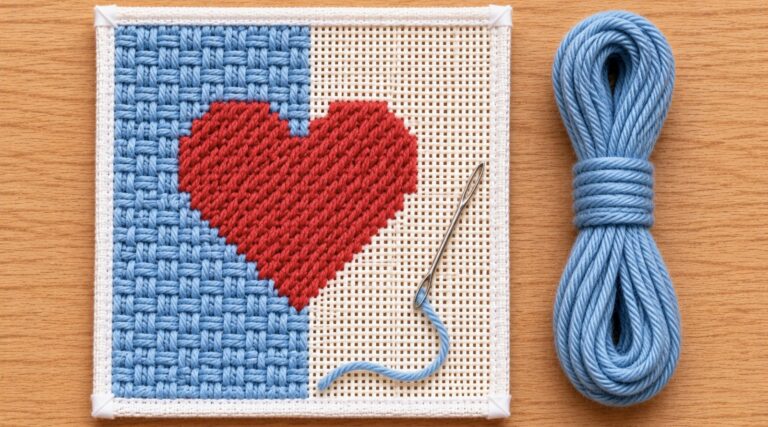
The basketweave stitch is a way of working the tent stitch in diagonal rows. On the front, it looks the same as any other tent stitch. On the back, the thread forms a woven pattern, like a basket. That woven back makes the piece strong and keeps the canvas from pulling out of shape, so stitchers use basketweave for backgrounds and other large areas.

Why use basketweave
- It distorts the canvas the least of the three tent stitches.
- It is the most durable. It suits pieces that get heavy use, such as cushions, belts, and seat covers.
- It gives even coverage over large areas.
The trade-offs: basketweave uses more thread than continental, and it takes more practice.
How basketweave works
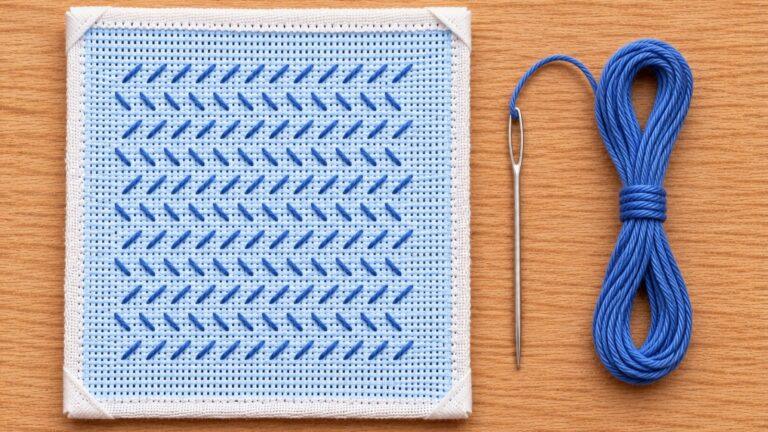
Every stitch is still a tent stitch. You bring the needle up at the lower left hole and take it down at the upper right hole, one intersection away. The difference is the order. You fill the area in diagonal rows, and you alternate the direction of each row:
- A down row travels from upper left to lower right.
- An up row travels from lower right to upper left.
How to do the basketweave stitch
- Start in the top right corner of the area. Make one tent stitch (stitch 1).
- Make stitch 2 in the square to the left of stitch 1.
- Make stitch 3 in the square below stitch 1. Stitches 2 and 3 form your first down row.
- Start the next row at the bottom. Make stitch 4 below stitch 3, then work up the diagonal: stitch 5, then stitch 6 at the top.
- Start the next row at the top. Make stitch 7 to the left of stitch 6, then work down the diagonal to stitch 10.
- Keep going. Each row is one stitch longer until you reach the edge of the area. Always alternate: one row down, one row up.
The needle trick
You can tell which way you are going by how the needle moves behind the canvas.
- On a down row, the needle passes straight down behind the canvas, under two horizontal threads.
- On an up row, the needle passes sideways behind the canvas, under two vertical threads.
If you notice the needle doing the same thing on two rows in a row, you have worked two rows in the same direction. That leaves a faint ridge on the front.
Poles and steps
Look closely at the canvas. At each intersection, either the vertical thread or the horizontal thread sits on top. Stitchers call a vertical thread on top a pole and a horizontal thread on top a step. The rule is: slide down the poles, and step up the steps. Work a down row over the intersections with poles, and an up row over the intersections with steps. Following this rule helps the stitches sit evenly. It also means the canvas decides your first row: if the stitch in the top right corner sits on a pole, your first row travels down, as in the diagram. If it sits on a step, your first row travels up.
Tips
- Do not stop in the middle of an area without a note. When you put the work down, finish a row and leave the needle where the next row starts, so you remember the direction.
- Start a new thread by running it under the stitches on the back. Run it straight up and down or straight across so it does not show on the front.
- Keep the pattern going at color edges. Follow the same diagonal even when a row stops short at another color.
- Use continental for single lines. Basketweave needs space. For a line one stitch wide, use continental stitch.
Common questions
Is basketweave the same as tent stitch?
Basketweave is one way of working the tent stitch. See the tent stitch guide for all three ways.
Does basketweave use more thread?
Yes. It uses more thread than continental or half cross, because more thread sits on the back.
Should a beginner learn basketweave?
Learn the continental stitch first with how to do needlepoint. Add basketweave when you stitch your first background.