Needlepoint Purse and Handbag Kits: How They Work
A needlepoint purse starts as a small stitched canvas. You then turn it into a clutch or handbag in one of two ways: slide it into a ready-made “self-finishing” bag, or have the canvas sewn into a bag. This guide explains both, what a purse kit includes, and what to check before you buy.
Two ways to make a needlepoint purse
| Self-finishing bag | Sewn purse | |
|---|---|---|
| How it works | You stitch a small canvas panel and fit it into a ready-made bag | The stitched canvas becomes the body or flap of the bag |
| Sewing needed | Little or none | A lot, or a professional finisher |
| Canvas size | Small, set by the bag | Larger |
| Best for | A first purse project | Experienced stitchers |
How self-finishing bags work
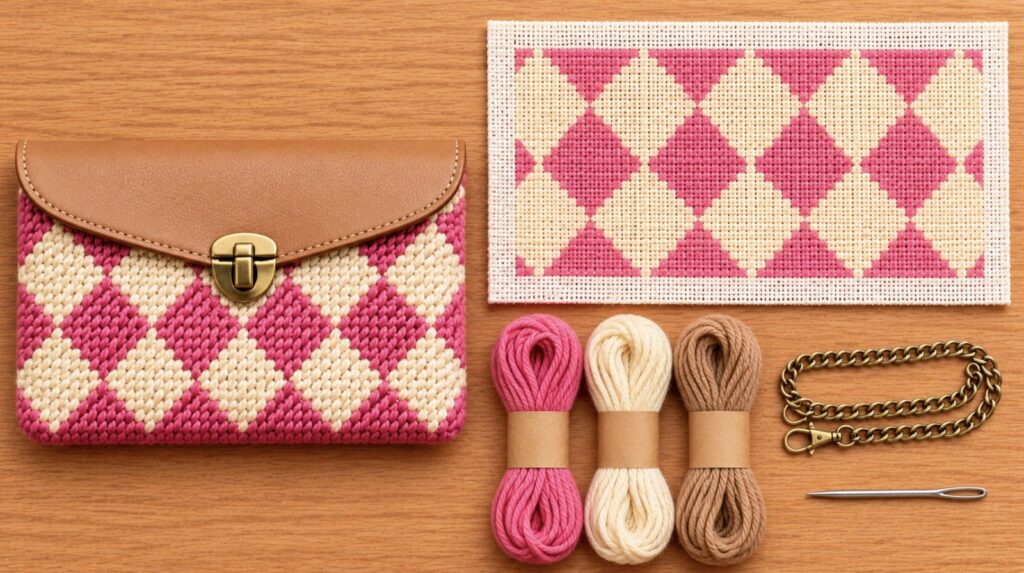
A self-finishing bag is a finished clutch or purse with a window or pocket made for a needlepoint panel. You stitch the panel, prepare it, and put it in. Common styles:
- Clear acrylic clutches. The stitched panel sits inside the clear box and shows through the front.
- Leather clutches with an insert. The panel fits a frame on the front flap. Some come with a removable chain strap.
- Small leather goods. Luggage tags, bag charms, and wallets work the same way with tiny panels.
Each bag takes one exact panel size. Examples sold today take panels of about 4 by 7 inches or 3 by 6 inches. Buy the bag first, or check its panel size before you choose a canvas. A canvas that is a quarter inch too big will not fit.
What a purse kit includes
Kits differ widely, so read the listing line by line.
- Canvas kits include the canvas, the threads, and a needle. You buy the bag or the finishing separately.
- Full kits add the self-finishing bag.
- Bag only. Many self-finishing bags come with no canvas or thread at all.
See what a kitted canvas includes for the terms shops use.
What to check before you buy
- Panel size. Does the canvas match the bag?
- Mesh. Small panels often use 18 mesh, which holds more detail in a small space. 13 mesh is easier to see. See needlepoint canvas mesh sizes.
- Thread. A purse gets handled. Wool and cotton stand up to wear better than delicate threads. See our needlepoint threads guide.
- Hardware. Look at the clasp, the strap, and whether the strap comes off.
- How the panel attaches. Some bags use adhesive, some a slip-in frame. Ask whether you can change the panel later.
How to finish a panel for a clear clutch
Here is how one common method for an acrylic clutch works. Your bag’s own instructions come first.
- Block the stitched canvas so it lies flat and square.
- Trim the bare canvas and clip the corners to reduce bulk. Do not cut close to the stitches.
- Work a binding stitch around the edge, so no bare canvas shows.
- Cut a piece of mat board slightly smaller than the stitched area and place it on the back.
- Check that the panel fits the clutch before you glue anything.
- Fold the canvas margin over the board and fix it with textile glue. Hold it with clips until it dries.
- Cover the back with self-adhesive velvet or felt.
- Slide the panel into the clutch.
Is a purse a good first project?
A small self-finishing panel is a fair second or third project. It is small, but it needs neat stitching and careful measuring, because every stitch shows. Start with an ornament or a coaster. Then read needlepoint finishing so you know what comes after the last stitch.