Needlepoint Threads: A Beginner’s Guide to Cotton, Wool and Silk
Needlepoint thread comes in three main fibers: cotton, wool, and silk. The right one depends on your canvas mesh and on how much wear the finished piece will get. This guide explains each type and helps you pick thread for your first project.
The main types of needlepoint thread
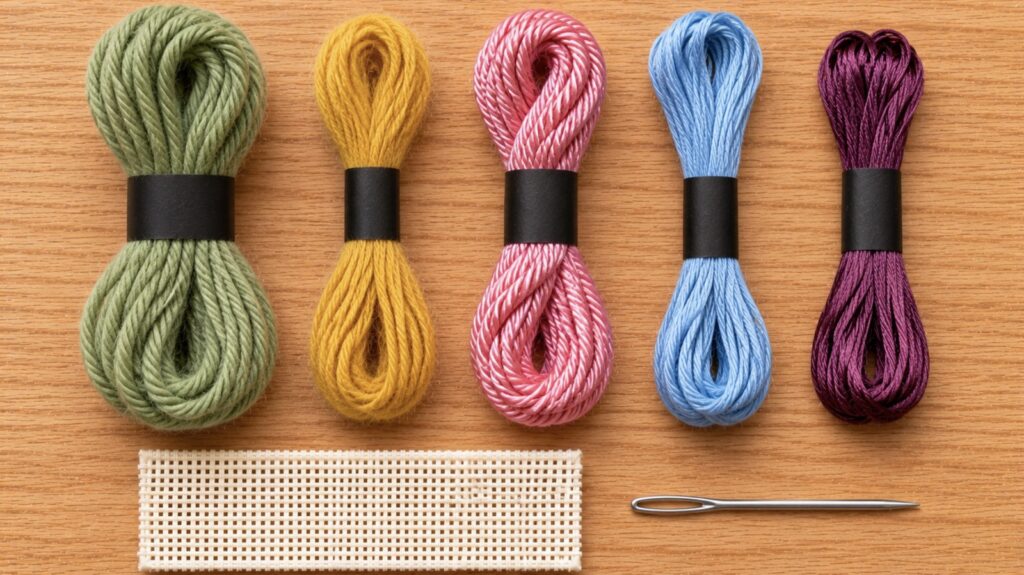
Stitchers sort thread into four groups: cotton, wool, silk, and specialty fibers.
| Fiber | What it is like | Good to know |
|---|---|---|
| Cotton | Smooth, strong, low cost | Easy to find. A good choice for a first project. |
| Wool | Thicker and soft, covers the canvas fully | Very durable. Suits pillows, belts, and key fobs. |
| Silk | Smooth with a natural shine | Glides through the canvas but tangles easily. Use shorter lengths. |
| Silk and wool blends | Soft with a slight shine and full coverage | Handle the skeins gently, because blends can fuzz. |
| Metallics and specialty threads | Sparkly, fuzzy, velvety, or ribbon-like | Use them for accents, not whole projects. |
Cotton threads
Cotton is affordable, durable, and sold in almost every craft store. You will meet three kinds.
- Pearl cotton is a twisted cotton thread with a clear shine. It comes in sizes from 3 to 12, and a lower number means a thicker thread. You do not separate it.
- Soft matte cotton is a thick thread with no shine. You do not separate it either. It covers 13 mesh canvas well, and many standard kits include it.
- Six-strand cotton floss is the same floss cross stitchers use. On 18 mesh canvas, stitchers usually use 4 to 6 strands together.
Wool threads
Wool is the classic needlepoint thread. It fills the canvas well and holds up to years of use.
- Tapestry wool is the heavier wool that most traditional needlepoint uses. It is often 4-ply, and you use it as it comes. It suits 10 to 14 mesh canvas.
- Persian wool has three strands that pull apart easily, so you can adjust the thickness to fit your canvas.
- Crewel wool is a single fine strand for delicate, detailed work.
Silk and specialty threads
Silk gives a smooth stitch with a soft glow. It costs more than cotton or wool, and it tangles more easily, so cut shorter lengths. Silk and wool blends combine the shine of silk with the fullness of wool.
Metallic, fuzzy, velvet, and ribbon threads add sparkle and texture. Stitchers use them in small areas: a fuzzy thread for an animal, a sparkly one for water or a star.
Match the thread to your canvas mesh
The rule is simple: the finer the canvas, the thinner the thread. A thread that is too thin leaves bare canvas showing. A thread that is too thick is hard to pull through.
| Canvas | Threads that fit |
|---|---|
| 13 mesh | Size 3 pearl cotton, soft matte cotton, tapestry wool, thicker silks and blends |
| 18 mesh | Size 5 pearl cotton, 4 to 6 strands of cotton floss, finer silks and blends |
Not sure which mesh you have? See needlepoint canvas mesh sizes.
Think about wear
An ornament hangs on a tree for a few weeks a year, so it can use delicate threads. A pillow, a belt, or a key fob gets handled every day. Use wool or cotton for those.
What are dye lots?
Makers dye thread in batches. The same color name can look slightly different from one batch to the next. Many brands print a dye lot number on the label. When you stitch a large area such as a background, buy all the thread you need at once and check that the dye lot numbers match. Some brands, such as DMC, do not use dye lots, so you can buy more later without a color shift.
How to handle thread while you stitch
- Cut lengths of 18 to 24 inches, about the length of your forearm. Longer thread twists and knots.
- Every few stitches, let the needle hang freely so the thread can untwist.
- Buy a little extra. No fixed rule tells you how much thread a canvas needs.
- If you run low, know that the basketweave stitch uses more thread than the continental stitch. See our tent stitch guide for the difference.
Which thread should a beginner buy?
Start with cotton. It costs little, it forgives mistakes, and you can find it anywhere. Use size 3 pearl cotton or soft matte cotton on 13 mesh canvas. Wool is also a good first thread. If you buy a kit, the threads already match the canvas. See our picks in needlepoint kits for beginners.