T Stitch in Needlepoint: An Easy Open Background Stitch
The T stitch is an open needlepoint stitch. You make small slanted stitches on every other canvas intersection and leave the rest bare. It fills large backgrounds fast, uses little thread, and lets a painted canvas show through.
What the T stitch is
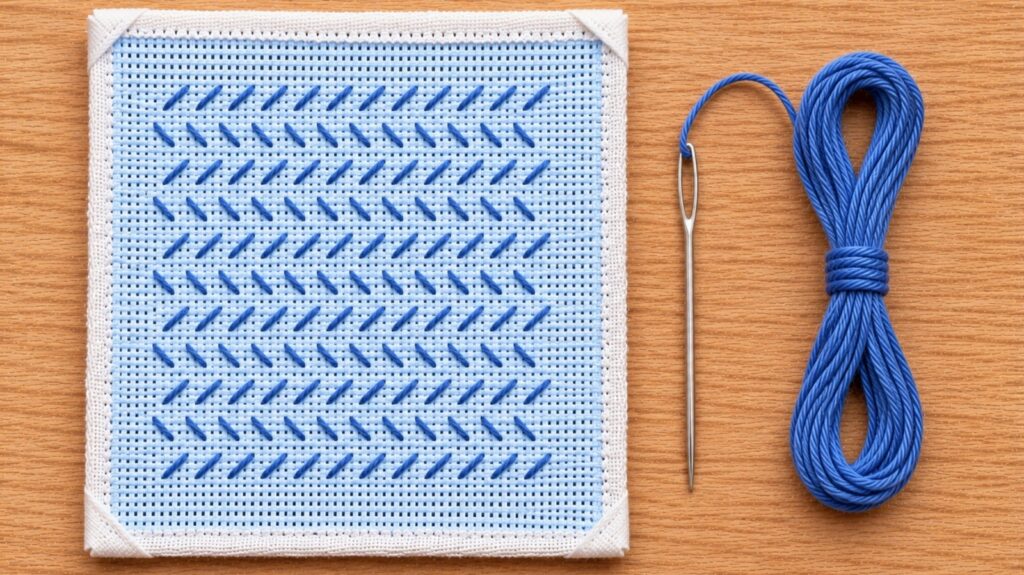
The T stitch mixes two tiny stitches: the tent stitch, which slants up to the right, and the reverse tent stitch, which slants up to the left. You work them in horizontal rows and skip one intersection between stitches. The two slants together form a light, lacy pattern.
How to do the T stitch
- Row 1. Make one tent stitch over a canvas intersection, slanting up to the right. Skip the next intersection. Make another tent stitch. Repeat to the end of the row.
- Row 2. Work back in the other direction. Make reverse tent stitches, slanting up to the left. Place each one under a gap in row 1.
- Row 3. Repeat row 1.
- Row 4. Repeat row 2. Keep going until you fill the area.
Check your first two rows against the diagram before you go on. The pattern depends on even gaps, and an early mistake repeats down the whole area.
Where to use it
- Large backgrounds
- Skies and other soft, light areas
- Any painted canvas where you want the painted color to show
The T stitch works best on painted canvas. On blank canvas, the bare threads show between the stitches. For stitches that cover the canvas fully, see needlepoint background stitches.
Tips for a clean T stitch
- Use a thin, light thread. A thick thread crowds the open pattern.
- Keep the back tidy. Long strands across the back can show through the open areas on the front.
- Start and end threads behind stitched areas, not behind bare canvas.
- For an even lighter look, skip two intersections between stitches.
T stitch vs tent stitch
A full tent stitch background covers every intersection. The T stitch covers half of them, so it takes about half the stitches and less thread. The trade-off is coverage: the tent stitch hides the canvas, and the T stitch does not. Learn the full version in our tent stitch guide.