Needlepoint Frames: Stretcher Bars vs Scroll Frames
A needlepoint frame holds the canvas tight while you stitch. That keeps your tension even and stops the canvas from pulling out of shape. The two main kinds are stretcher bars and scroll frames. This guide explains both, shows you how to size and mount stretcher bars, and helps you decide whether you need a frame at all.
Do you need a frame?
No. You can stitch needlepoint in your hand. Many people do, and the tent stitch works fine that way. But a frame gives you clear benefits:
- The canvas stays square, so it needs little or no blocking when you finish.
- Your stitches come out more even.
- Tight canvas makes the holes easier to see and count.
- Decorative stitches, textured threads, and beads sit better on tight canvas.
- On a stand, a frame leaves both hands free.
Stitching in hand has its own advantages. The work rolls up and travels easily, and you can “scoop” the needle in and out in one motion, which is faster for tent stitch.
Stretcher bars vs scroll frames
| Stretcher bars | Scroll frame | |
|---|---|---|
| What it is | Four wooden bars that join into a frame the size of your canvas | Two rods that the canvas rolls around, joined by side bars |
| How the canvas attaches | Tacks or staples along the edges | Fixed to the rods, then rolled |
| Shows | The whole canvas at once | Only the section you are working on |
| Best for | Small and medium canvases | Medium and large canvases |
| Good to know | Light and low cost. Reusable. | Works well with a floor or lap stand. |
Embroidery hoops are a poor match for needlepoint. Canvas is stiff, and most canvases are square or rectangular, so stitchers use bars or scroll frames. Plastic clip frames work for small and medium pieces.
How stretcher bars work
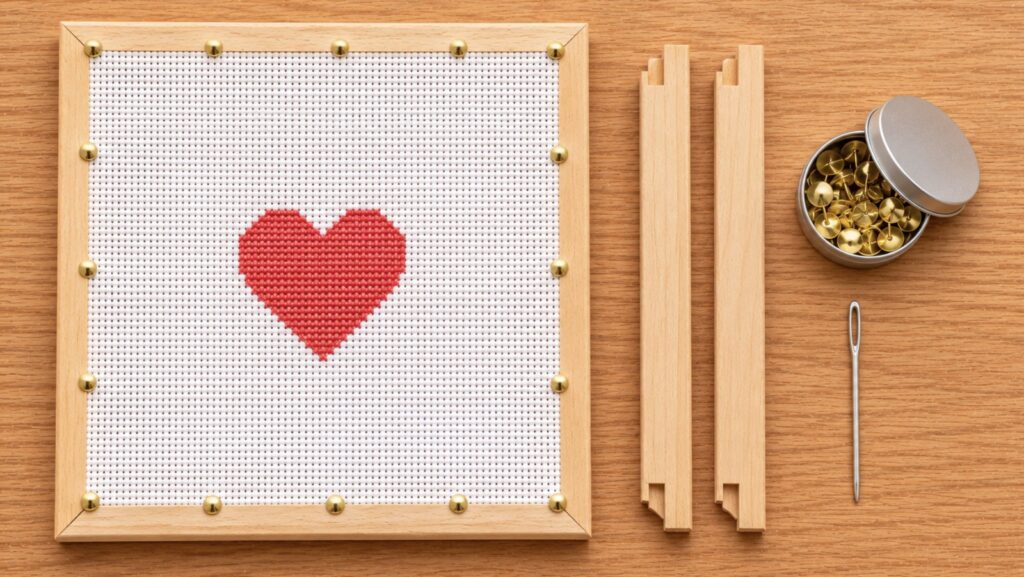
Stretcher bars are flat wooden bars with notched ends. Shops sell them in pairs of the same length. You buy two pairs, one for the width and one for the height, and push the corners together.
- Mini bars are half an inch wide and come in lengths up to 18 inches. They suit ornaments and other small canvases.
- Regular bars are one inch wide and come in lengths up to 28 inches.
- You cannot join a mini bar to a regular bar. Both kinds are reusable.
How to pick the size
- Lay the canvas flat.
- Measure the whole canvas from edge to edge, both ways. Include the bare margin around the design.
- Buy one pair of bars for each measurement.
- If the canvas falls between two bar lengths, choose the shorter length. The canvas has to reach the bars to take a tack.
Example: for a canvas that measures 10 by 12 inches edge to edge, buy one pair of 10 inch bars and one pair of 12 inch bars.
How to mount a canvas on stretcher bars
- Join the bars. Push the four corners together and check that the frame is square.
- Lay the canvas on the frame. Line the canvas threads up with the bars so the grid sits straight.
- Tack the center of each side first. Push one tack into the middle of the top bar. Pull the canvas snug and tack the middle of the bottom bar. Do the same for the left and right.
- Work toward the corners. Add tacks from the center out, a little at a time on each side, and pull the canvas tight as you go.
- Check the tension. The canvas should feel firm, with no ripples, and the grid should still look square.
Brass tacks made for needlepoint come with a small lever for pulling them out, and you can reuse them. Staples also work. You can mount the canvas on top of the bars or on the underside. Both are correct, so use the one that feels more comfortable.
Which frame should you buy?
- A small ornament or first kit: no frame, or a set of mini stretcher bars.
- A pillow-size canvas: regular stretcher bars, or a scroll frame if you want a stand.
- A large canvas you will work on for months: a scroll frame on a floor stand.
For the other basics, see needlepoint tools and accessories. For what happens after the last stitch, see needlepoint finishing.