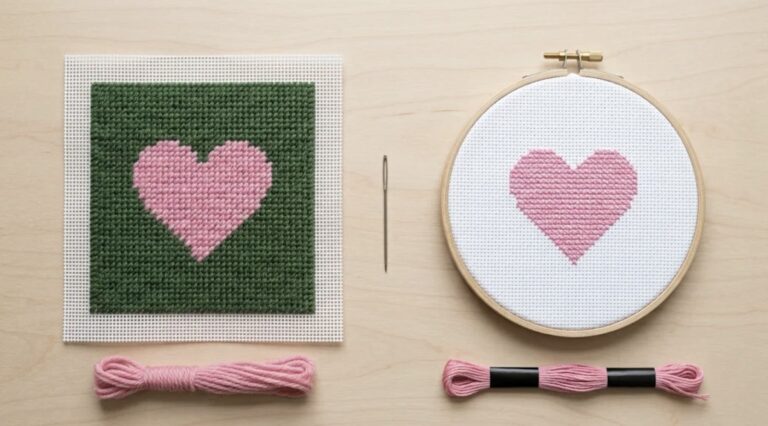
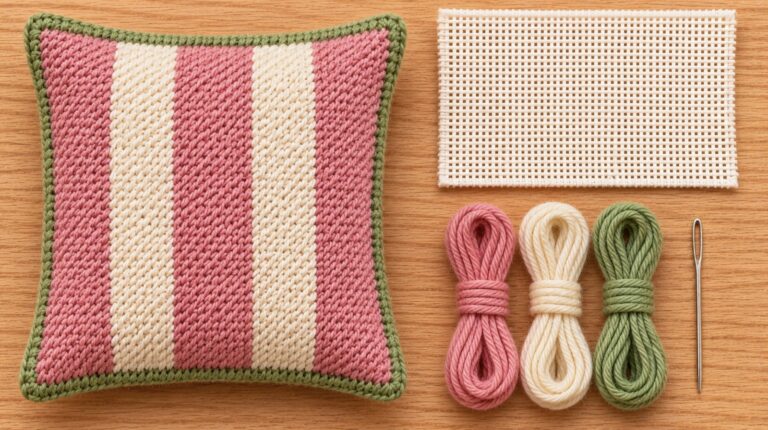
Needlepoint vs Tapestry: What Is the Difference?
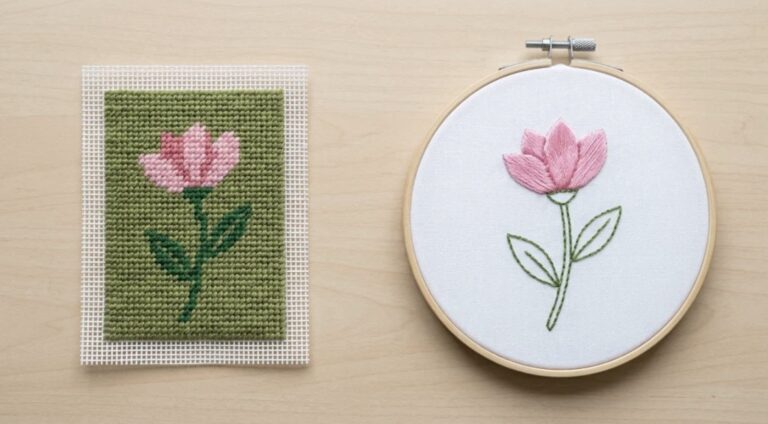
Needlepoint and tapestry are two different crafts. Needlepoint is embroidery: you stitch yarn through a ready-made canvas with a needle. Tapestry is weaving: you build the cloth and the picture together on a loom. People mix up the names because in the United Kingdom, needlepoint is often called “tapestry.” This guide explains the difference and the name.
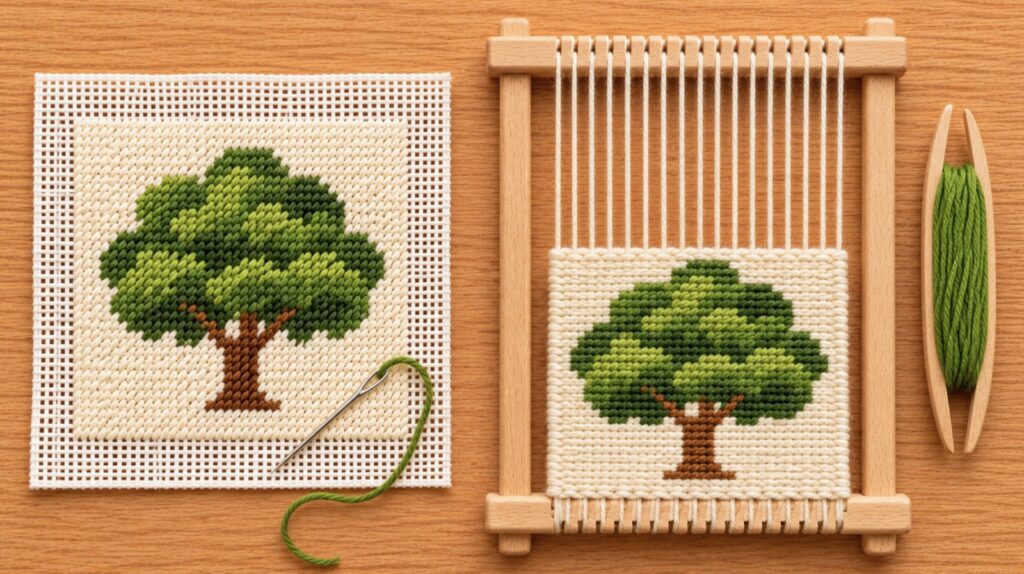
The short answer
| Needlepoint | Tapestry | |
|---|---|---|
| What it is | Embroidery on canvas | Weaving |
| Tool | A blunt tapestry needle | A loom |
| Starting point | A finished canvas with open holes | Bare warp threads stretched on a loom |
| How the picture forms | You cover the canvas with stitches | You weave colored weft threads over and under the warp |
| Typical size | Small to medium: ornaments, pillows, belts | Often large: wall hangings |
What needlepoint is
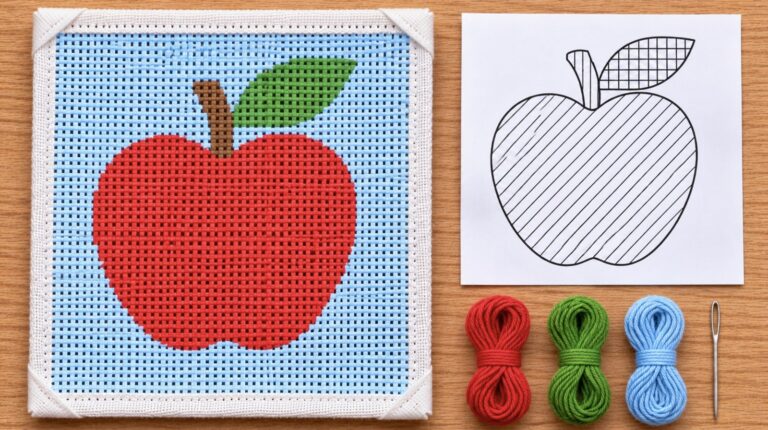
Needlepoint is a kind of canvas work. You stitch yarn through a stiff, open-weave canvas until the stitches cover it. The canvas stays inside the finished piece as its base. Read the full introduction in what is needlepoint.
What tapestry is
Tapestry is a woven textile, traditionally made by hand on a loom. The weaver stretches warp threads on the loom and passes colored weft threads over and under them. Two things set it apart from ordinary weaving:
- The weft hides the warp. In the finished piece you see only the colored weft threads.
- Each color stays in its own area. The weaver works a color back and forth only where the design needs it. The thread does not run from one side of the cloth to the other.
The picture is part of the cloth itself. Nothing is stitched on afterward.
Why needlepoint gets called tapestry
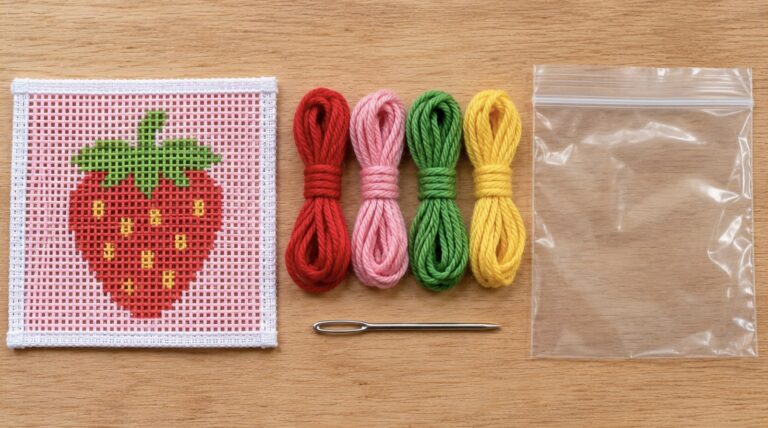
- British usage. In the UK, needlepoint is often called “tapestry,” and sometimes “canvas work.” A British “tapestry kit” is a needlepoint kit.
- The look. A canvas fully covered in tent stitch has a dense, woven look, a little like a woven tapestry.
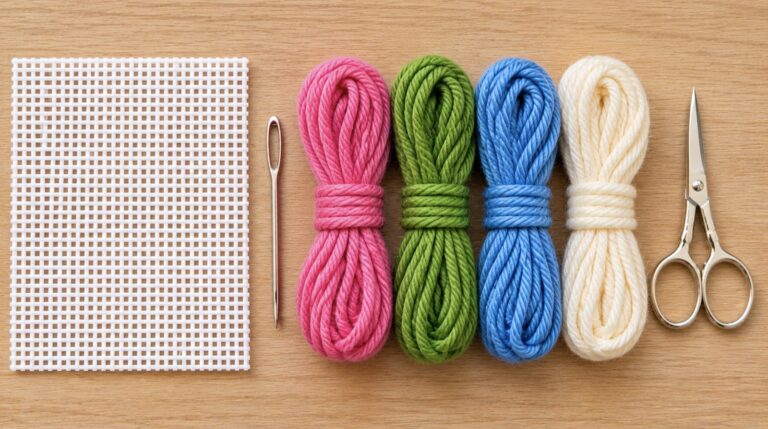
- The supply names. The blunt needle is a “tapestry needle,” and the thick yarn is “tapestry wool.” Both are needlepoint supplies.
- French. The French word tapisserie covers both crafts.
A famous example of the mix-up
The Bayeux Tapestry is not a tapestry. It is an embroidery about 68 meters long, thought to have been made in England in the 1070s, and it shows the Norman Conquest of 1066. People call it a tapestry in the loose sense of a large hanging with pictures on it.
Famous woven tapestries include The Lady and the Unicorn in Paris and The Hunt of the Unicorn at the Metropolitan Museum of Art in New York.
How to tell them apart
- Look at the back. Needlepoint shows a canvas grid with stitches and thread ends on it. A woven tapestry has no separate base cloth.
- Look at the edge. Needlepoint often has bare canvas around the stitching, or a seam where the canvas was turned under.
- Look at the surface. Needlepoint stitches usually slant, and they sit in a square grid. In a woven tapestry, the threads run straight across in rows and form fine ridges.
Which words to use when you shop
- In the US, search for “needlepoint.”
- In the UK, “tapestry kit” and “tapestry canvas” usually mean needlepoint.
- “Tapestry needle” and “tapestry wool” are needlepoint supplies in both countries.
- “Tapestry weaving” or “tapestry loom” means the woven craft.
Which one should you learn?
If you want to stitch a design that is already printed or painted for you, with a needle and a small frame, choose needlepoint. If you want to weave cloth on a loom, choose tapestry weaving. This site covers needlepoint. Start with how to do needlepoint.
For two more look-alike comparisons, see needlepoint vs cross stitch and needlepoint vs embroidery.