Cross Stitch for Beginners: How to Start, Step by Step
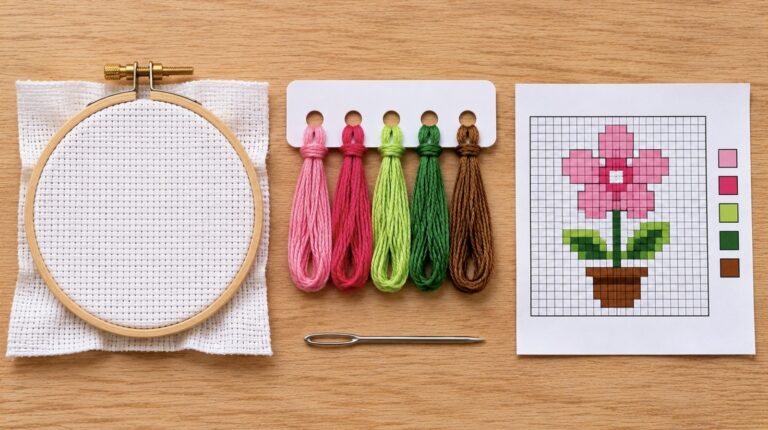
Cross stitch is one of the easiest needlecrafts to start. You make small X-shaped stitches on a gridded fabric, following a chart, until the Xs form a picture. This beginner guide covers the supplies, how to read a pattern, how to make your first stitches and how to finish.
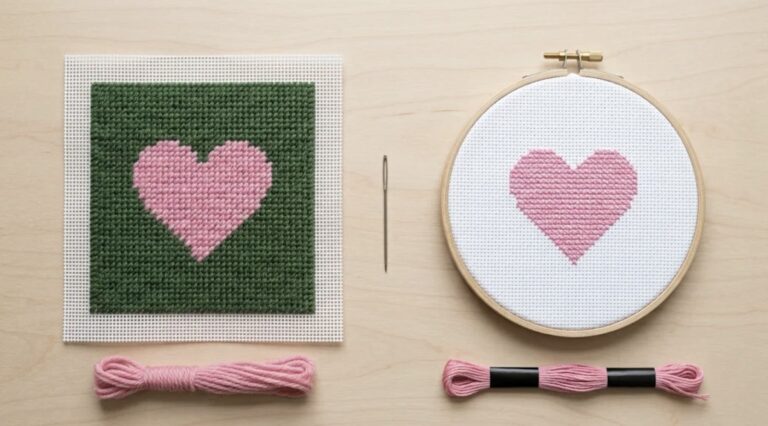
Wondering how this differs from needlepoint? See needlepoint vs cross stitch.
What you need to start
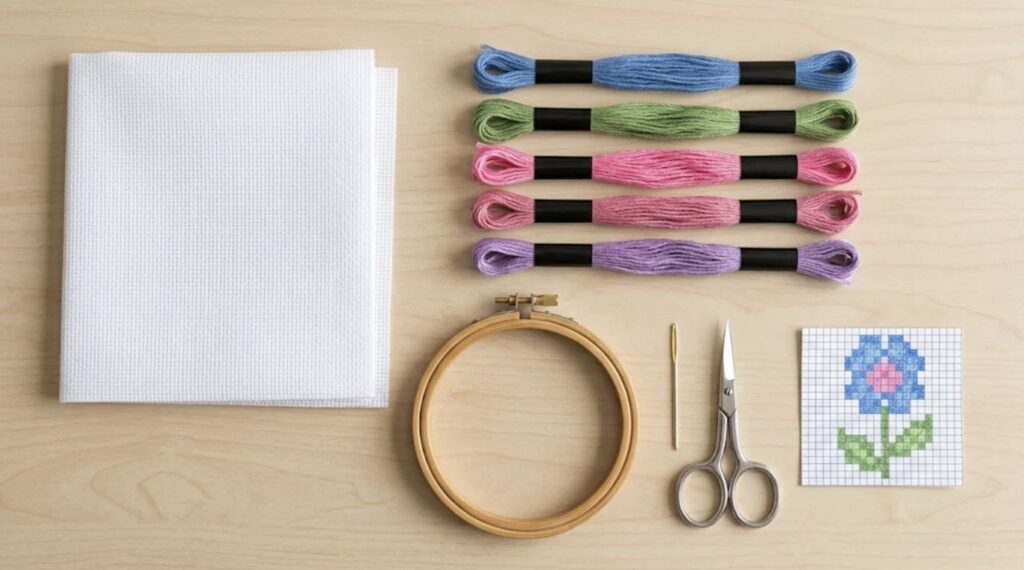
- Fabric. 14-count Aida is the usual beginner fabric. It has 14 squares per inch and clear holes at each corner.
- Needle. A size 24 tapestry needle, which has a blunt tip, suits 14-count Aida.
- Thread. Six-strand cotton embroidery floss. On 14-count Aida you normally stitch with 2 of the 6 strands.
- Embroidery hoop. A 5 or 6 inch hoop keeps the fabric taut.
- Small sharp scissors.
- A pattern, or a beginner kit that includes all of the above.
How to read a cross stitch pattern
A counted cross stitch pattern is a grid. Each square on the chart is one stitch on the fabric. A symbol or color in the square tells you which thread to use, and the key lists the thread number for each symbol. You leave empty squares unstitched.
Most charts mark the center with arrows on the top and side edges. Starting from the center keeps the design in the middle of your fabric.
How to cross stitch, step by step
Step 1: Find the center of the fabric
Fold the fabric in half, then in half again, and pinch the corner where the folds meet. That point is the center. Put the fabric in the hoop with the center in the middle and tighten the hoop until the fabric is firm.
Step 2: Prepare the thread
Cut about 18 inches (45 cm) of floss. Pull out one strand at a time, then put two strands back together. Separating them first helps the stitches lie flat. Thread the needle.
Step 3: Start without a knot
Bring the needle up from the back and leave a tail of about an inch behind the fabric. Hold the tail against the back and make your first few stitches over it so that it is trapped. Knots make bumps and can pull through the holes.
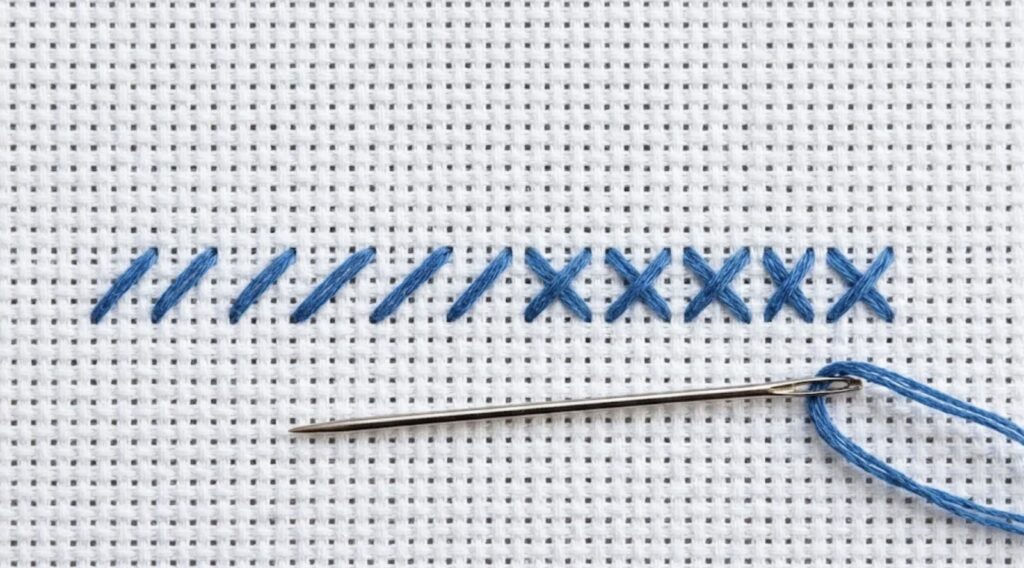
Step 4: Make a cross stitch
- Bring the needle up at the bottom left corner of the square (1).
- Take it down at the top right corner (2). This is the first half of the stitch.
- Bring it up at the bottom right corner (3).
- Take it down at the top left corner (4). The X is complete.
Step 5: Stitch in rows
For a row of the same color, it is faster to make all the first halves along the row, then come back along the row making the second halves. Whichever way you work, keep the top half of every X slanting in the same direction. That is what makes the finished piece look even.
Step 6: Finish a thread
When the thread is getting short, turn the work over and slide the needle under three or four stitches on the back. Pull through and snip the end.
Tips for neat cross stitch
- Count twice, stitch once. Most mistakes are counting mistakes.
- Mark off the chart as you go, with a pencil or a highlighter on a copy.
- Do not carry thread far across the back. It can show through the fabric. End it and start again.
- Let the needle hang now and then so the thread untwists.
- Keep an even, gentle tension. The stitches should sit on the fabric without puckering it.
- Wash your hands before stitching.
How to finish your first piece
When the stitching is done, take the fabric out of the hoop. If it needs cleaning, wash it gently by hand in cool water with a little mild soap, rinse it and roll it in a towel to remove water. Press it face down on a clean towel so you do not flatten the stitches. Then frame it or make it into a card, ornament or bookmark.
Common beginner mistakes
- Starting at a corner and running out of fabric. Start from the center.
- Using all six strands of floss at once.
- Top stitches slanting in different directions.
- Pulling the thread too tight.
- Choosing a large design with many colors as a first project.
Common questions
Is cross stitch easy for beginners?
Yes. There is one basic stitch to learn, and a small kit can be finished in a few evenings.
What is the difference between counted and stamped cross stitch?
In counted cross stitch the fabric is blank and you follow a chart. In stamped cross stitch, the design comes printed on the fabric and you stitch over it.
What is the best fabric count for a beginner?
14-count Aida. The squares are large enough to see clearly, and most beginner patterns and kits use it.