Vintage Cross Stitch Patterns: Where to Find Them and How to Stitch Them
Vintage cross stitch patterns have a look that new designs rarely match: faded roses, alphabets, baskets of flowers, and borders that repeat around the edge. This guide explains where to find old charts you can use, how to read them, and how to stitch one with modern fabric and floss.
What counts as a vintage pattern
Stitchers use the word loosely. It can mean a real old chart, such as a booklet from a family sewing box or a scan of a book printed more than a century ago. It can also mean a new design drawn in an old style.
Printed charts are older than most people expect. According to the Embroiderers’ Guild of America, the first Berlin wool work pattern came off the press in 1804. Printers produced a black-and-white grid first, and workers added the colors by hand afterward. Stitchers worked those charts in cross stitch or tent stitch.
Where to find vintage patterns
- Family and thrift finds. Old booklets and magazine pages turn up in sewing boxes, thrift stores, and estate sales.
- The Antique Pattern Library. This nonprofit project scans old craft publications and offers them as free PDFs. Its cross stitch section lists books from the 1800s and early 1900s, such as the Priscilla Cross Stitch Book from 1899. Visit antiquepatternlibrary.org.
- Vintage-style new patterns. Many designers draw new charts with old motifs and muted colors. These come with a modern color key, which makes them easier for a first project.
- Pattern books. Collections gather many motifs in one place. See our guide to cross stitch pattern books.
Can you copy an old pattern freely?
Old does not always mean free to copy. In the United States, works published in 1930 or earlier are in the public domain as of January 1, 2026, according to Duke University’s Center for the Study of the Public Domain. Newer charts may still be under copyright, even when someone has posted a scan online.
Stitching a chart you own, for yourself, is the simple case. Check the terms before you share or sell copies. The Antique Pattern Library, for example, offers its scans free for personal use and does not allow anyone to sell copies. This is general information, not legal advice.
How old charts differ from new ones
| Feature | Old chart | New chart |
|---|---|---|
| Colors | Colored squares or black-and-white symbols | Symbols with a numbered floss key |
| Floss numbers | Often none | Listed for each color |
| Fabric advice | Often none | Fabric and count listed |
| Finished size | You work it out from the stitch count | Usually listed |
How to stitch from a vintage chart
- Count the design. Count the squares across and down. Enter those numbers in our fabric calculator to get the fabric size.
- Redraw unclear parts. If the scan is faded, copy the motif onto cross stitch graph paper, one square at a time.
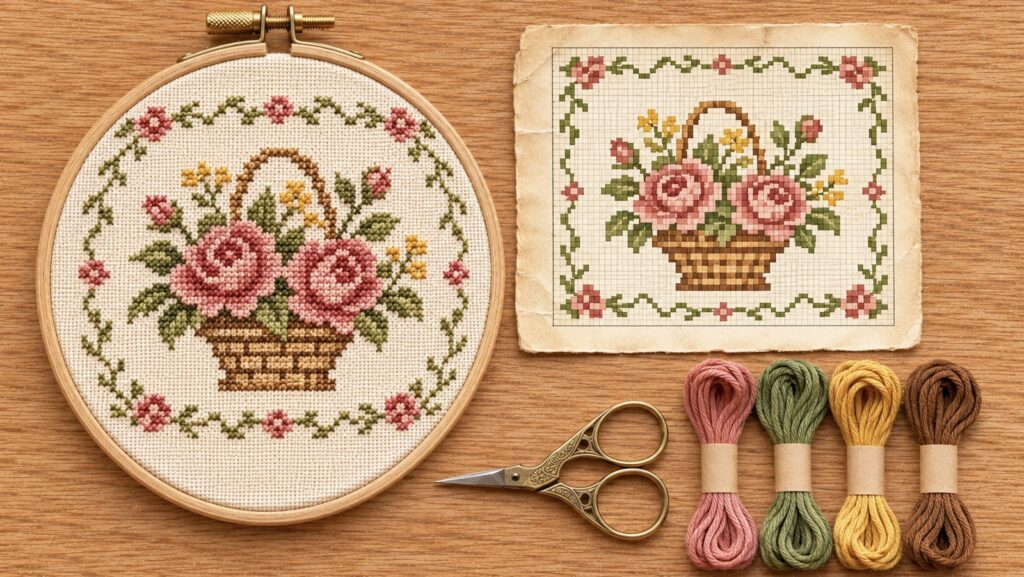
- Choose your colors. Pick floss that matches the old look: dusty rose, sage green, mustard, and soft brown. Lay the skeins together before you start.
- Pick the fabric. Cream or oatmeal fabric suits old designs better than bright white. Our fabric guide explains the counts.
- Stitch one small motif first. Try one flower or one letter before you commit to a full sampler.
Good first vintage projects
- A single rose or a small basket of flowers in a hoop.
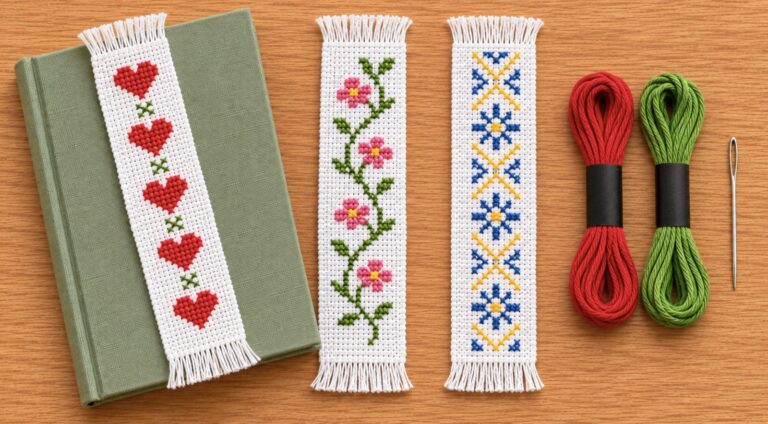
- A repeating border stitched as a bookmark.
- Your initials from an old alphabet.
- A small sampler with a border, a motif, and a date. Our wedding sampler guide shows what to include.